
Let’s talk about dark forests! One of the most important steps in the fairytale heroine’s journey is entering the dark forest.
We see this in “Snow White” when she flees the huntsman: she must run though the forest. In “Sleeping Beauty,” as I pointed out, the forest grows up around her. We do not see the dark forest in Perrault’s “Cinderella,” but the forest actually comes to Cinderella in the Grimms’ version: she asks her father for the branch of a hazel tree, which she plants on her mother’s grave, and it showers gold and silver down on her in the form of the three dresses and dancing shoes. Most fairytales involving journeys have dark forests in them, for both a practical and a metaphorical reason. Practically, journeys used to involve dark forests: the tales I’m looking at are generally European, and there were dark forests between the villages, towns, and castles, the places of civilization. Going anywhere, even to grandmother’s house, meant going through the forest. And in the forest lurked dangers, such as wolves and wicked ogres. But there is a metaphorical reason as well. The dark forest is an intuitive image for when we are lost, or possibly lost. It’s the place where we can lose our way and even ourselves.
For us, reading the fairy tales today, the dark forest functions as a metaphor for all the ways we get lost: anxiety, grief, depression. It’s where we can’t see ahead of us, where the trees are too dense. Where it’s too dark under the canopy. We look around and think, “Where am I going?” Or even, “Where is there to go? Is there a way out of here? Is there anything other than dark forest?”
There is, of course. There are kindly dwarves’ cottages, and huts on chicken legs, and castles ruled by white cats. You can get to those places, as long as you keep going. One thing fairy tales teach us is that there’s always a way out of the dark forest. Indeed, the dark forest often comes rather early in the tales. It’s an initial state of being lost. When you’re in the dark forest, most of the story is still to come.
There’s another thing I realized about the dark forest, when I was going through a small patch of it myself. (It was the forest of having a great deal of work to do, and too many deadlines, and not getting enough sleep.) At the time it came as such a revelation that I tweeted it, and so many people retweeted it that I realized it was something people needed to hear. It was this:
The heroine never dies in the dark forest.
Seriously, never. When you’re in the dark forest, you’re afraid. You feel as though it might be the end of the story: you might be lost forever. But it’s never the end of the story, and that’s another thing that fairy tales teach us. The dark forest is where you’re lost and afraid, but it’s not where you die. It’s only a part of the journey, not the whole of it. The dark forest has one power over you, which is the power to frighten you. But that’s it. And that realization can help you keep going.
I should say here that the heroine does die later, but in a fairy tale, death is a precursor to rebirth. Death is actually necessary for the heroine to become who she is. Sort of like the caterpillar becoming a butterfly.
So if you’re in a dark forest right now, and I bet some of you are, because patches of them can appear around any bend of the road, here’s what I want you to keep in mind:
1. You are a heroine.
2. You are on a journey, and on that journey, a number of things can happen.
3. One of those things is entering the dark forest. But other heroines have been on this journey before you, and they have something to teach you about the dark forest. Think of their journeys as maps that you can use for your own.
4. The heroine never dies in the dark forest.
5. The dark forest only has one power: to make you afraid. It’s all right to be afraid. But keep going, keep going.
6. On the other side of the dark forest are all sorts of adventures. You will have to share your loaf of bread with the birds. You will find a tree with golden apples. A talking snake will tell you what you need to know. You don’t know yet what those adventures will be. Keep going and find out.
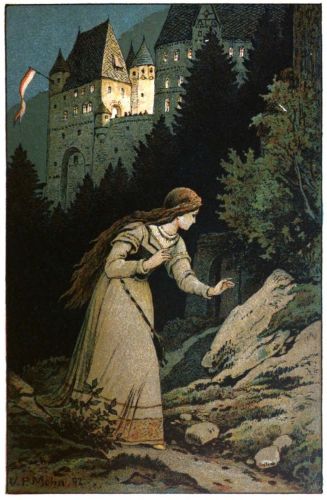
(The image is an illustration for “Cinderella” by Viktor P. Mohn.)

 Theodora Goss: Essays